Tuesday, April 28, 2009

It's Not Luck


We've all noticed the current trend for young people to marry later and later, deferring the day until various conditions are met. Education completed, career established, the field played sufficiently, etc. , as Mark Regnerus, author and sociology professor, noted recently in his Washington Post Article,
Convinced that there actually is a recipe for guaranteed marital success that goes something like this: Add a postgraduate education to a college degree, toss in a visible amount of career success and a healthy helping of wealth, let simmer in a pan of sexual variety for several years, allow to cool and settle, then serve. Presto: a marriage with math on its side.

Too bad real life isn't like that. Marriage actually works best as a formative institution, not an institution you enter once you think you're fully formed. We learn marriage, just as we learn language, and to the teachable, some lessons just come easier earlier in life. "Cursed be the social wants that sin against the strength of youth," added Tennyson to his lines about springtime and love.

I realize that marrying early means that you engage in a shorter search. In the age of online dating personality algorithms and matches, Americans have become well acquainted with the cultural (and commercial) notion that melding marriage with science will somehow assure a good fit. But what really matters for making marriage happen and then making it good are not matches, but mentalities: such things as persistent and honest communication, conflict-resolution skills, the ability to handle the cyclical nature of so much of marriage, and a bedrock commitment to the very unity of the thing. I've met 18-year-olds who can handle it and 45-year-olds who can't.

Today, there's an even more compelling argument against delayed marriage: the economic benefits of pooling resources. My wife and I married at 22 with nothing to our name but a pair of degrees and some dreams. We enjoy recounting those days of austerity, and we're still fiscal conservatives because of it, better poised to weather the current crisis than many, because marriage is an unbelievably efficient arrangement and the best wealth-creating institution there is. Married people earn more, save more and build more wealth compared with people who are single or cohabiting. (Say what you will about the benefits of cohabitation, it's a categorically less stable arrangement, far more prone to division than marriage.) We can combine incomes while reducing expenses such as food, child care, electricity, gas and water usage. Marriage may be bourgeois, but it's also the greenest of all social structures. Michigan State ecologists estimate that the extra households created by divorce cost the nation 73 billion kilowatt hours of electricity and more than 600 billion gallons of water in a year. That's a mighty big carbon footprint created in the name of solitude. Marriage may not make you rich -- that's not its purpose -- but a biblical proverb reveals this nifty side effect: "Two are better than one, because they have a good return for their work."

So while many young Americans mark their days in the usual ways -- by hitting the clubs, incessantly checking Facebook, Twittering their latest love interest and obsessing about their poor job prospects or how to get into graduate school -- my applause goes out to those among them who've figured out that the proverb was right. One of those is Jennifer, a 23-year-old former student of mine. She's getting married this fall. It wasn't religion that made her do it. It wasn't fear of being alone. It was simply affection. She met Jake while still in college and decided that there was no point in barhopping through her 20s. Her friends balked. She stood firm. Now they're bridesmaids.

There is, unfortunately, quite a bit of negativity attached to an earlier marriage. Young people face both parental and peer pressure discouraging the idea, while extolling the supposed benefits of waiting. But, it seems the studies and surveys are once again confirming the wisdom of Scripture. The older we get, the more set in mind, opinions and our own ways of doing things. Compromise may prove more difficult. Getting started together at a younger age, working in tandem, and with the energy of youth, can help achieve that goal of unity. It takes commitment of course, and the decision to love. No luck involved here.

Saturday, April 11, 2009

Good Griefs and Greetings

He Has Risen!
It's the Greek Easter greeting (in Greek of course). I'm supposed to be cleaning my house, but instead, guess what's being done? This. Meanwhile the windows are dirty and the mini-blinds are dusty. Though, I discovered today the origins of "Spring Cleaning" - likely not news to anyone else. It's the Jewish tradition of getting rid of all the chametz in the weeks before Passover. Anything with a possibility of yeast, mold, dust, dirt, etc. etc. All of which are symbolic of the yuck in our spiritual lives - sin in other words. That word no one wants to use anymore.

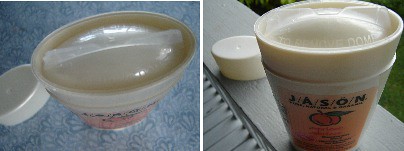
On another note - get ready for a rant. Observe this packaging. A lovely graphic, the product sounds good, apricot scented deodorant, pure, natural and organic. For sensitive skin. But go ahead, try to get it open. My sensitive skin is turning red. Do they try extra hard thinking up ways to make things difficult for consumers? Just for a laugh? This is similar to the "child-proof" aspirin bottles. Have you ever tried, in the grip of a raging headache, to get the top off one? Or pity the poor arthritis sufferer, with pain in her hands? Hey, and I've yet to meet the child who couldn't get those tops off in nothing flat.


The directions are there, if you can read them. They can be barely made out, tilting it at an angle, standing in good light. It's clear on clear, for easy reading. Then try to do what it says: "to remove dome twist up product." Right, if it only would. Twist, move, get off! I'm going to need my grandson for this. As a PS - I did try twisting from the bottom (at first I was afraid that would just smash deodorant up against the lid dome) so yes, success at last. It wasn't the obvious, and it wasn't clear. Clear directions don't necessarily clarify.


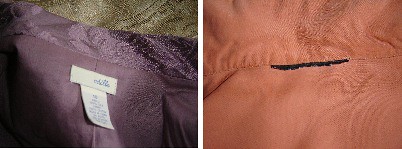
Here's another pet peeve - those labels in shirts made of unfortunate, synthetic, hyper-itchy materials, designed by their manufacturers to torment consumers. On purpose. You can buy a good brand of clothing, soft natural materials in the article, then they double stitch the label in, made totally out of skin irritants. On the right you see what needs to be done - rip, cut or tear them off. I've made holes in the back of a few nice tops, due to impatience. You need a decent seam-ripper. Okay, I'd better get back to getting rid of the chametz so we don't gross everyone out tomorrow with a dirty house.

Tuesday, April 7, 2009

Credit Where Due Please

We're all pretty much sticklers for giving credit where due, to ourselves and (hopefully) to others as well. Look closely here and you'll see I've got my name on these items I've made (labels can be fun). Bits of conversation, poems, even a few obscure lines, have got to be quoted, with author's name given a proper mention. Movies have long credit rolls for all the creative work; we know artists by their particular style. We don't somehow believe that a Ford evolved into a Ferrari all by itself. There were people involved, hard at work, using their creative gifts. And, they want credit.


Yet, wonder on wonder, we can look out of our own complicated eyeballs, and presume to think that they, as well as the rest of our very complex created world, evolved by random mutations and "natural selection." I was, to give credit, reading this morning from a little daily devotional put out by the Institute for Creation Research.
If an automobile presupposes an automaker, and a clock implies a clockmaker, surely the infinitely more intricate and complex eyes and ears of living creatures require an eye-maker and an ear-maker! "The hearing ear, and the seeing eye, the LORD hath made even both of them" (Proverbs 20:12).

The most basic of all scientific laws--the law of cause and effect (no effect greater than its cause)--becomes utmost nonsense if the cosmos is the product of chaos and the universe evolved by chance. "The fool hath said in his heart, There is no God" (Psalm 14:1).

Every creature, from the single-celled amoebae to the amazing human body, bears the impress of intricate planning and construction. The notion that such complex structures could evolve by random mutations and natural selection is simply a measure of the audacity of human rebellion and the absurdity of humanistic reasoning. Such things never happen in the real world, and there is no real scientific evidence whatever for "vertical" evolution from one kind to a higher kind. The only genuine evidence for evolution is the fact that the leaders of intellectualism believe it, and the only reason they believe it is their frantic desire to escape God.
In fact, there is much better scientific rationale, from the very same evidence, for belief in a Creator God. If you are interested, there is another good site for information and further research here.

Friday, April 3, 2009

Bird Brains

The birds have moved on. Another phase in their life cycles. Or, for some, an end. This nest was on the ground; blown down by the wind. Who knows how long it was empty; at any rate, very symbolic for us humans. However, the birds build it for one purpose only. To hold eggs. They don't need a place to sit, watch TV, exercise, eat meals, work on a hobby, etc. It's just for the kids. You might say they have small brains, one track minds. But, at least they do what they were created to do.

That's what I ask myself from time to time. Am I doing all I was meant to do? Writing too many food posts may be causing all this introspection. Though, introspecting can be good for us, in moderation.